Archives
-

Vol. 1 No. 1 (2025)
We are proud to introduce the first issue of the Information Retrieval Research Journal (IRRJ). IRRJ is the only peer-reviewed diamond open access journal that focuses exclusively on the information retrieval research community. The journal provides free and un-restricted on-line open access to papers in information retrieval, and runs fully on volunteer work by editors, reviewers, a production editor, a webmaster, and an advisory board. IRRJ does not require subscription fees nor article processing fees: At IRRJ the readers do not pay and the authors do not pay either. Instead, IRRJ plans to be completely self-funded, running on micro-donations, using resources and infrastructure provided by friend organizations and universities. We are grateful to the Radboud University and Royal Netherlands Academy of Arts and Sciences (KNAW) for providing the initial funding and infrastructure.
-
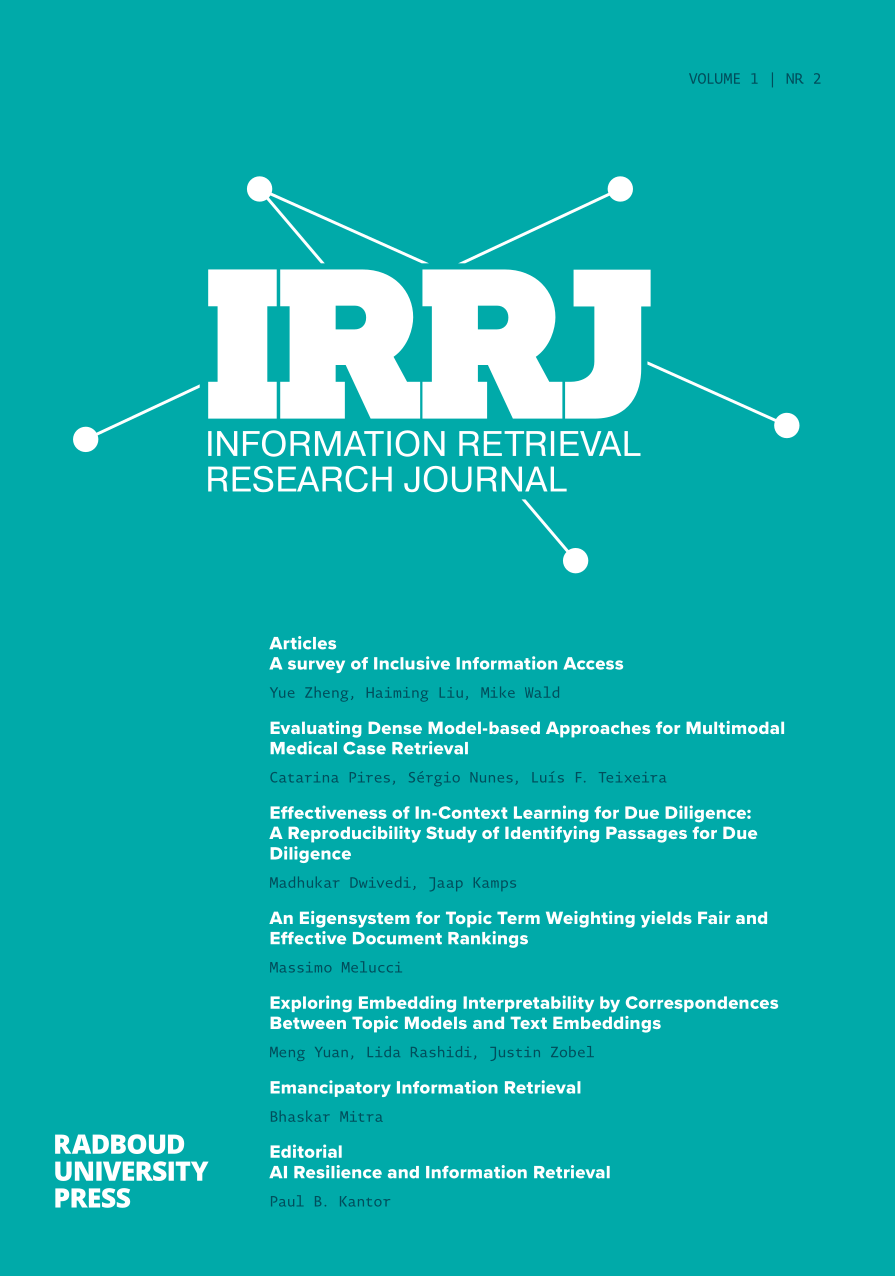
Vol. 1 No. 2 (2025)
In the second issue of IRRJ, Paul Kantor, writes an editorial arguing for a more critical adoption of generative AI in information retrieval (IR). He puts his concerns under three distinct headings: consistency, confidence, and completeness. Also in this issue, a survey of Inclusive Information Access by Yue Zheng and colleagues; Catarina Pires and colleagues discussing the Multimodal Medical Case Retrieval; Madhukar Dwivedi and Jaap Kamps presenting a reproducibility study of Identifying Passages for Due Diligence; Massimo Melucci's latest study of achieving fair rankings; Meng Yuan exploring the Correspondences Between Topic Models and Text Embeddings; and finally, Bhaskar Mitra's provocation for the role of information retrieval in emancipatory struggles. We hope this work will deepen your knowledge of IR. Thank your for reading IRRJ.
-

Vol. 2 No. 1 (2026)
The third issue of IRRJ contains excellent research papers: CRAWLDoc, a system for contextual ranking and bibliographic metadata extraction from web resources by Fabian Karl and Ansgar Scherp; Simple techniques for efficient top-k batch query processing by Zhixuan Li and Joel Mackenzie; An exploration of online content accessibility from an autism-informed perspective by Hrishita Chakrabarti and Maria Soledad Pera; Detecting subtle and overt forms of online conflict with multi-objective learning by Oliver Warke et al.; and CASTlog, a comprehensive log of children's interactions with the child adaptive search tool by Christine Pinney et al. In the editorial, Stephen Robertson reviews "The Curious Case of Mike Lynch: The Improbable Life & Death of a TechBillionaire" based on his personal encounter with Lynch.
-
online first
Vol. 2 (2026)This issue is scheduled to be finalized in December 2026.